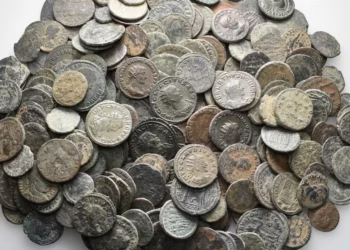

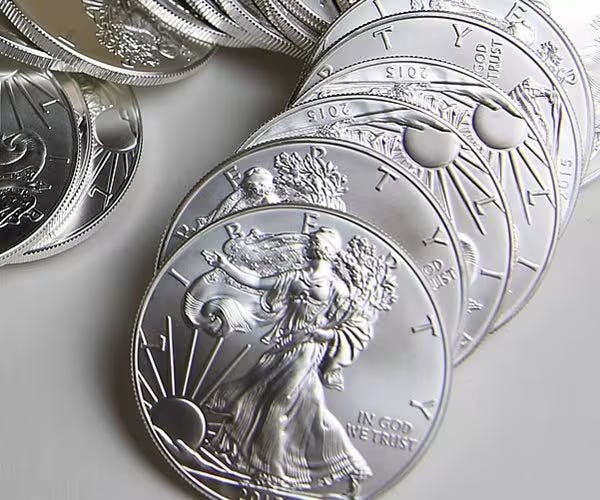
I was going through some old Australian coins the other day—pre-decimal shillings and florins from my grandfather’s collection. Heavy. Solid. Real silver.
Then I grabbed a modern coin from my pocket. Light. Cheap feeling. Copper and nickel.
When did we stop using silver? And more importantly—why?
Seemed like an odd thing to just… change. Silver had been money for thousands of years. It’s mentioned in the Bible, used in ancient Egypt, coined by the Greeks and Romans. For most of human history, if you said “money,” you probably meant silver.
So what happened to it?
What We Assume
Most of us assume we evolved naturally from barter to metal coins to paper money to digital currency. Progress marching forward. Paper is more convenient than metal, digital is more convenient than paper. Makes sense.
Silver just became obsolete, right? Old-fashioned. Heavy. Impractical for modern commerce. Gold kept its status because it’s rarer and more valuable, but silver faded away naturally as we modernized.

That’s what I thought, anyway.
But silver didn’t gradually fade away. It was removed. Deliberately. Through specific legislative acts. In multiple countries. Around the same time period.
And the reasons given… don’t quite add up.
The Crime of 1873
Let’s start with America, since what happens there usually ripples outward.
In 1873, the US Congress passed the Coinage Act. Sounds boring and technical, right? Just updating currency regulations. But buried in that legislation was a fundamental change: silver was quietly removed from standard coinage. The US went from a bimetallic standard (both gold and silver as money) to a gold-only standard.
It was done with minimal public discussion. Most Americans had no idea it happened.
Silver advocates later called it “The Crime of 1873.” Not because it was technically illegal—it wasn’t. But because it fundamentally changed the monetary system without public debate, and the people most affected (farmers, debtors, workers who used silver) never got a say.
Before 1873, you could take silver to the mint and have it coined into money. After 1873? Only gold. Silver was demonetized with a legislative stroke.
Why? The official explanation was to “stabilize” the currency, reduce confusion about exchange rates, and align with European gold standards. Technical monetary reform.
But here’s what strikes me as odd: Silver had been money for thousands of years. It was working fine. Why remove it?
Australia’s Timeline
We followed a similar path, just a bit later:
Pre-1946: Sterling silver coins (92.5% silver). Your grandfather’s shillings and florins were real silver. You could feel the weight of it.
1946: Silver content reduced to 50%. Still some silver, but diluted. The coins got lighter, cheaper.
1966: Decimal currency introduced. Silver removed entirely. Copper-nickel replaced it.
The explanation? Cost of silver was rising. More economical to use base metals. Modernizing the currency. Aligning with international standards.
Sounds reasonable. Except…
If silver was becoming too expensive to use in coins, doesn’t that prove it was valuable? So why remove valuable money and replace it with cheap metal that loses value?
Think about it: We removed silver from coins in 1966. Within a few years, silver prices soared. Those old coins we pulled from circulation would be worth multiples of their face value today if they still contained silver.
The timing seems… convenient. Remove the valuable thing right before its value becomes obvious.
The Global Pattern
Here’s what’s interesting: This happened almost everywhere, within a relatively short timeframe.
United States:
- 1873: Silver demonetized from coinage
- 1964: 90% silver removed from quarters and dimes
- 1971: Final break from any metal backing (Nixon closes gold window)
United Kingdom:
- 1920: Silver content reduced
- 1947: Silver removed from coins entirely
Australia:
- 1946: Silver reduced to 50%
- 1966: Silver removed completely
Most developed nations: Between 1960-1975, silver gone from coinage.
Within a 10-15 year window globally, silver disappeared from money. Was this coordinated? Just coincidence? Economic necessity?
Maybe. But the pattern is striking.
What Replaced It
After silver was removed, what did we get?
- Paper currency backed by nothing (post-1971)
- Base metal coins (copper, nickel, zinc)
- Digital accounting entries
- Fiat systems everywhere
Remember from Essay #1: Fiat currency can be created infinitely. No physical constraint.
Remember from Essay #2: Banks create money through lending. Fractional reserve banking means unlimited monetary expansion.
But here’s the thing: You can’t “create” physical silver. There’s only so much in the ground. You have to mine it, refine it, coin it. There’s a natural limit.
Silver as money would constrain the money supply. Remove silver, and suddenly money supply can expand infinitely.
Convenient for banks, isn’t it?
The Silver Price Today
Now here’s where it gets really interesting.
Today, silver’s “price” is determined primarily by paper contracts—futures and derivatives traded on exchanges. These are contracts promising to deliver silver at a future date.
But here’s the problem: The volume of paper silver contracts is often 100-200 times larger than the actual physical silver available to deliver.
It’s like writing 200 cheques when you’ve only got money for one. As long as everyone doesn’t try to cash them at once, you’re fine. But if they do…
Physical silver trades at a premium to the paper price. There’s a disconnect. People who actually want the metal pay more than the “official” price would suggest.
Industrial demand for silver exceeds mining supply. It’s used in electronics, solar panels, medical equipment—consumed and not recycled. The above-ground supply should be dwindling.
Yet the price remains suppressed relative to gold. That historical 15:1 gold-to-silver ratio? Currently sitting around 80:1.
Either silver got massively less valuable relative to gold over the last century, or something else is going on.
The Questions I Can’t Stop Asking
Why remove silver from money systems worldwide within a 15-year window?
Who benefited from demonetizing it?
If it was “too expensive” for coins, why not just use less of it? Why remove it entirely?
And why, after removal, was a paper contract system established that seems designed to suppress the price?
Let me try connecting some dots:
If you’re a bank, your profit comes from creating money through lending. Physical, finite money (like silver) limits how much you can create. Remove the physical backing, and you can lend infinitely.
If you’re a government, finite money limits your spending. Wars are expensive. Social programs are expensive. You can’t just print more silver. But you CAN print more paper currency once the metal backing is gone.
If you’re an existing wealth holder, cheap money (currency that loses value) pushes people into assets like stocks, property, bonds. Your assets inflate in dollar terms. You get richer in a currency that’s getting weaker.
I’m not saying it’s a conspiracy. I’m saying the incentives all point in one direction, and that’s exactly what happened.
Connecting To What We’ve Learned
So let’s review the pattern:
Essay #1: Dollars aren’t money—they’re currency. Backed by nothing since 1971. Losing value by design.
Essay #2: Private banks create currency through lending. Unlimited supply. Those closest to creation benefit most.
Essay #3: Silver WAS money for 4,000 years. Then it was systematically removed in the 1960s-70s. Also when fiat took over.
See it?
Physical money (gold/silver) = limits on money supply = limits on bank lending = limits on bank profits = limits on government spending
Remove physical backing = unlimited paper/digital currency = unlimited bank lending = unlimited bank profits = unlimited government spending
The system we have now requires unlimited money creation to function. Physical money would break that system.
So physical money had to go.
Make Of It What You Will
Whatever happened to silver?
It was removed. Systematically. Globally. Within a few decades. Then its price was managed through paper contracts disconnected from physical supply.
Maybe it’s all above board. Maybe there are perfectly good economic reasons I’m not seeing. Maybe the modernization story is completely true and I’m reading patterns that aren’t there.
But consider this: If you were running a banking system that profits from creating money from nothing, wouldn’t physical, finite money be your biggest constraint?
Wouldn’t you want it removed?
I’m just noticing what happened. The dates. The coordination. The timing. The fact that it happened right before the entire global monetary system went full fiat.
Draw your own conclusions.
Next essay: What if someone built money that can’t be inflated, can’t be controlled, and can’t be removed?
Side note: If you’ve got any pre-1966 Australian coins lying around, keep them. They’re not just historical curiosities—they’re actual silver. And that matters more than most people realize.
End of Essay #3